
Introduction
Understanding how to highlight leadership and service is essential in academic, professional, and institutional settings. These attributes signal initiative, collaboration, and a commitment to community—qualities that are increasingly valued by employers, admission committees, and organizational leaders. Demonstrating leadership and service effectively can distinguish individuals in competitive environments and contribute to stronger institutional cultures.
As expectations rise for accountability and impact, there is a growing need for measurable and transparent indicators of leadership and service. Stakeholders want to see clear evidence of contributions, not just claims. Whether through quantifiable outcomes, documented roles, or third-party recognition, clarity and verification have become critical.
To meet these demands, various methodologies and tools have emerged to assess and communicate leadership and service. These include competency frameworks, digital portfolios, 360-degree evaluations, and structured reflective narratives. By using these tools, individuals and institutions can present a credible and comprehensive picture of leadership and service activities.

Defining Leadership and Service
Leadership
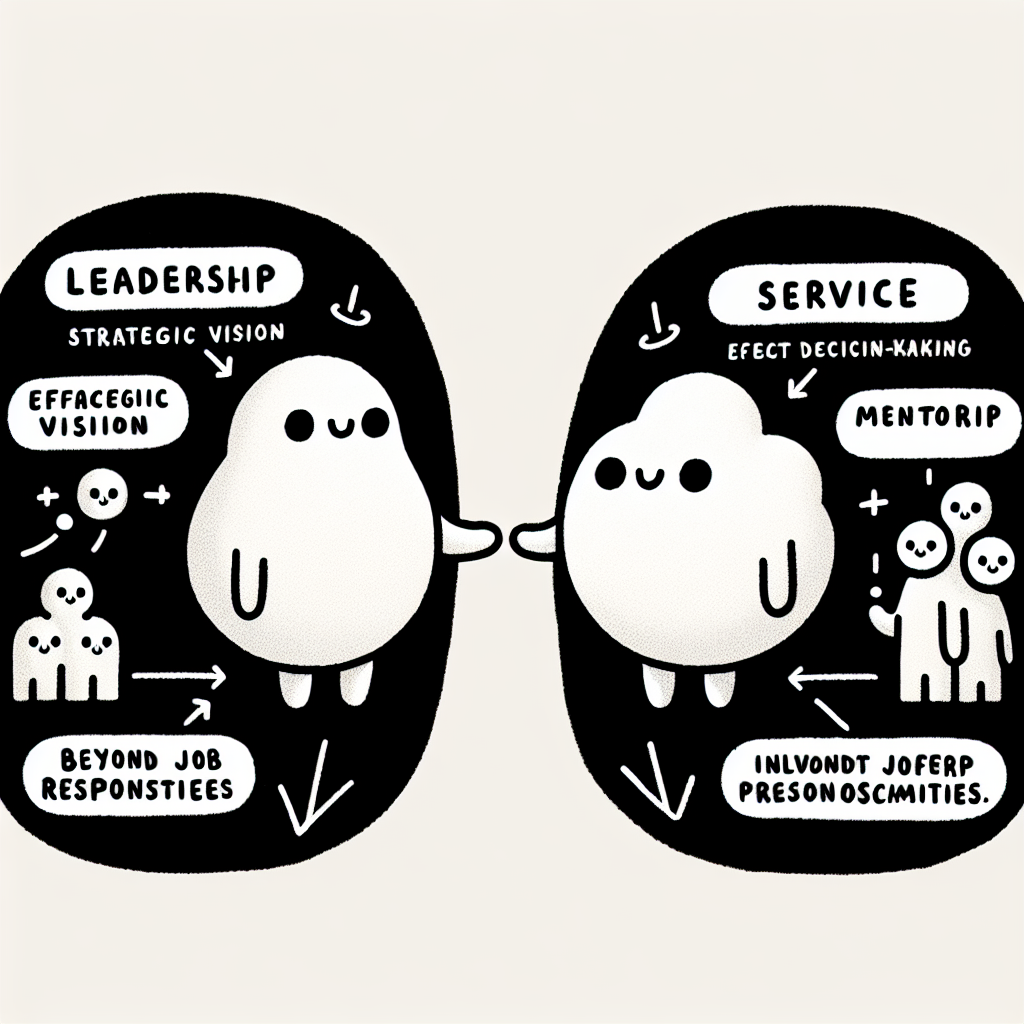
Understanding how to highlight leadership and service begins with clearly defining what leadership entails. Leadership is often demonstrated through strategic vision and effective decision-making. This includes setting long-term goals, aligning team efforts, and navigating challenges to achieve desired outcomes.
A key component of leadership is mentorship and team development. Strong leaders invest in building the capacity of others by providing guidance, fostering collaboration, and creating opportunities for growth. This contributes to a more resilient and capable team environment.
Leadership also involves driving innovation and influencing change. This may include initiating new programs, implementing process improvements, or advocating for policy reforms that have a meaningful impact on an organization or community.
Service
Service refers to consistent and impactful contributions beyond one’s primary job duties. This includes active participation in institutions, communities, and professional societies. Examples include serving on advisory boards, organizing events, or supporting institutional initiatives.
Volunteerism, mentorship, and committee participation are central to service. These activities demonstrate a commitment to supporting others and advancing shared goals without the expectation of personal gain.
Service roles can also involve governance, outreach, and public engagement. Whether through serving on a nonprofit board, leading a public awareness campaign, or representing an organization in community forums, these contributions are essential in showing how to highlight leadership and service in a broader context.
Quantifying Academic Leadership
Bibliometric Approaches
Bibliometric tools are essential for quantifying academic leadership by providing objective measures of research output and influence. These tools analyze publication data to assess how researchers contribute to their fields and collaborate with others.
Key indicators include:
- Publication Output: The number of peer-reviewed articles, conference papers, and books authored.
- Citation Impact: Metrics such as the h-index or total citation count that reflect how often a scholar's work is referenced by others.
- Co-authorship Networks: Diagrams and statistics showing the extent and diversity of a researcher's collaborations, which can highlight leadership in team science and interdisciplinary projects.
A more structured approach is provided by the Bibliometric Index for Academic Leadership, which offers a framework to assess research efficiency and output. This method includes metrics that emphasize not only quantity and impact but also the strategic organization and mentoring roles often associated with strong academic leadership.
Case Studies and Applications
Bibliometric methods are increasingly used in faculty evaluations and institutional benchmarking. Universities apply these metrics to identify candidates for promotion, tenure, and leadership roles. For example, individuals with high citation impacts and extensive co-authorship networks are often recognized for their ability to lead large, productive research teams.
Comparative studies have also shown how leadership metrics vary across disciplines and institutions. In fields like biomedical sciences, high publication output and citation rates are common, while in humanities, leadership might be demonstrated through fewer but highly influential publications. Understanding these differences is crucial for fairly assessing how to highlight leadership and service in diverse academic contexts.

Institutional Leadership Benchmarking
One of the most effective ways to understand how to highlight leadership and service at the institutional level is through benchmarking tools and global rankings. These provide comparative insights into how universities perform in areas such as academic leadership, service contributions, and research impact.
Global Rankings and Profiling Tools
The U.S. News & World Report's Best Global Universities Ranking evaluates institutions based on academic research and global reputation. This ranking system serves as a benchmark for assessing leadership in academia by comparing universities' research output, collaborations, and citation impact. Institutions that rank highly often demonstrate leadership through sustained academic excellence and global engagement.
Similarly, the Global Institutional Profiles Project by Clarivate provides a multi-dimensional view of institutional performance. It integrates bibliometric data, research funding, and reputation metrics to assess how institutions lead in their fields. This tool is especially useful for identifying how service and leadership manifest across different academic sectors.
Evaluation Criteria and Transparency
Transparent and consistent evaluation criteria are essential for recognizing institutional leadership and service. The article "Developing a Method for Evaluating Global University Rankings" argues for robust methodologies that fairly reflect leadership qualities and service contributions. It emphasizes that clear criteria help institutions understand and improve their leadership roles.
The Leiden Ranking 2011/2012 offers another example by focusing on bibliometric indicators such as scientific collaboration, publication output, and citation impact. These indicators help highlight how institutions contribute to the academic community, both through leadership in research and service-oriented collaboration.
By leveraging these tools and criteria, institutions can better understand how to highlight leadership and service in ways that are visible, measurable, and aligned with global standards.

Demonstrating Personal Leadership and Service
In Academic Portfolios
To effectively demonstrate personal leadership and service in academic portfolios, highlight roles that show initiative and influence. This includes mentorship of students or junior faculty, active participation in departmental or university committees, and leadership in curriculum development. These contributions reflect a commitment to institutional service and educational advancement.
Quantifying research impact is another key area. Use citation metrics such as total citations, h-index, and i10-index to showcase scholarly influence. Including information on awarded research grants further supports leadership in advancing knowledge and securing institutional support.
In Professional Settings
In professional environments, leadership and service are often demonstrated through direct responsibility and strategic influence. Document experiences where you've led teams, managed complex projects, or contributed to shaping organizational strategy. These activities illustrate both operational leadership and a broader vision for progress.
Participation in professional associations and industry initiatives also reflects service beyond one's immediate role. Volunteer roles, committee work, or organizing professional development events show a commitment to advancing the field and supporting peers.
In Community Engagement
Leadership and service extend beyond academia and the workplace. Engage with the community through outreach programs, public lectures, or partnerships with non-academic organizations. These efforts demonstrate a broader societal impact and a commitment to public education and engagement.
Service-learning initiatives, where academic goals align with community needs, are another strong example. Taking on civic leadership roles—such as serving on local boards or leading community projects—further highlights a dedication to public service and the application of expertise for the common good.
Effectively showing how to highlight leadership and service in each of these areas strengthens a holistic profile of personal and professional impact.

Tools and Strategies for Effective Presentation
Structuring CVs and Resumes
When considering how to highlight leadership and service in CVs and resumes, it's important to create clearly labeled sections dedicated to these areas. A distinct "Leadership and Service" section allows reviewers to easily identify relevant experiences. Within these sections, use bullet points that incorporate metrics and concise narratives to illustrate the scope and results of your contributions. For example, stating "Led a team of 10 volunteers to organize a community health fair attended by over 500 residents" conveys both leadership and impact.
Digital Portfolios and Online Profiles
Digital platforms like ORCID, Google Scholar, and LinkedIn offer useful spaces for showcasing leadership and service experiences. On LinkedIn, the "Featured" and "Projects" sections can be used to highlight major initiatives, while recommendations and endorsements can serve as testimonials of leadership qualities. ORCID and Google Scholar can be used to link leadership in collaborative research or mentoring roles to specific publications or projects, reinforcing your profile with verifiable contributions.
Grant and Promotion Applications
In grant proposals and promotion dossiers, aligning your leadership and service with institutional missions or funding agency priorities strengthens your case. Use evidence-based examples, such as leading an outreach program that increased STEM participation in underrepresented communities, to demonstrate alignment and impact. Clearly articulating outcomes, such as growth in program participation or measurable improvements in community engagement, shows how to highlight leadership and service in ways that resonate with reviewers.

Challenges and Ethical Considerations
When exploring how to highlight leadership and service, it is essential to consider several challenges and ethical factors that can affect fairness and accuracy.
One major concern is the over-reliance on quantitative metrics. While numbers such as the count of projects led or hours volunteered can provide some insight, they often fail to capture the depth, context, and impact of leadership and service. Relying too heavily on these figures can disadvantage individuals whose contributions are more qualitative in nature or occur in settings where formal documentation is limited.
Another challenge lies in navigating disciplinary and cultural differences in how leadership is defined and perceived. In some fields, leadership may be associated with formal titles or administrative roles, while in others, it may be demonstrated through mentorship, collaboration, or innovation. Similarly, cultural backgrounds influence how individuals express and value service, which can lead to misinterpretation or under-recognition if a narrow framework is applied.
Promoting inclusivity and recognizing diverse forms of service is also critical. Traditional definitions of service may overlook contributions such as community engagement, advocacy, or peer support, especially when performed by individuals from underrepresented groups. Broadening the scope of what counts as leadership and service ensures that valuable, though unconventional, efforts are acknowledged.
In short, a thoughtful, inclusive approach is necessary to ethically and effectively highlight leadership and service across varied contexts.

Future Directions
As organizations and institutions continue to explore how to highlight leadership and service, several emerging trends are shaping the future of recognition and evaluation.
One major development is the integration of artificial intelligence (AI) and data analytics in leadership evaluation. These technologies can provide more objective assessments by analyzing patterns in communication, decision-making, and team dynamics. For example, AI tools can track how often individuals initiate collaborative efforts or contribute to strategic outcomes, offering measurable insights into leadership effectiveness.
There is also a growing emphasis on interdisciplinary and collaborative leadership. Modern challenges often span multiple fields, requiring leaders who can work across traditional boundaries. Recognizing leadership in these contexts means valuing contributions that bridge departments, organizations, or even sectors, and highlighting service that facilitates cross-functional teamwork.
Lastly, institutions are seeking to develop standardized frameworks for service recognition. These frameworks aim to create clear, equitable criteria for acknowledging service contributions across roles and departments. By standardizing how service is documented and evaluated, organizations can ensure that such efforts are consistently and transparently included when assessing leadership.
These future directions underscore the evolving understanding of how to highlight leadership and service in more nuanced and inclusive ways.

Conclusion
Understanding how to highlight leadership and service is essential in both academic and professional settings. These contributions are multidimensional, encompassing formal roles, mentorship, community engagement, and institutional impact. Recognizing their importance is vital for individual advancement and institutional success.
By utilizing bibliometric tools, aligning with global benchmarks, and employing well-crafted narrative strategies, individuals can more effectively showcase their efforts. These methods provide structured, data-informed, and contextually rich ways to demonstrate the scope and significance of leadership and service.
However, continued innovation is necessary to ensure that evaluation practices remain fair, comprehensive, and sensitive to diverse contexts. As expectations and standards evolve, so too must the tools and frameworks used to assess and communicate leadership and service contributions.

 SHARE ON FACEBOOK
 SHARE ON TWITTER